
This page hands you a ready-to-play 10-question 80s music quiz, a categorized question bank for hosting your own game night, and the strategies that separate casual guessers from real experts. You'll find:
- A sample round mixing audio clues, lyric matches, and chart trivia
- 35 extra questions sorted from easy to expert, ready to copy for parties
- Scoring rules that reward speed and fewer hints
- A quick path to play curated 80s playlists on Songle, no sign-up required
Ready to test yourself? Jump to the sample quiz below, or head straight to Songle to start a full playlist run.
Key Takeaways
An effective 80s music quiz combines escalating difficulty, immediate answer explanations, and a scoring system that rewards fewer clues and faster answers.
| Point | Details |
|---|---|
| Structure rounds in tiers | Use easy, medium, hard, and one expert boss question to keep all skill levels engaged. |
| Score speed and clue economy | Reward faster answers and fewer clue reveals to encourage real expertise over guessing. |
| Explain every answer | Add a one-line fact after each question, similar to Britannica's model, to reinforce learning. |
| Mix genres deliberately | Group pop, rock, new wave, and synthpop questions in blocks rather than scattering them randomly. |
| Play full playlist runs on Songle | Songle lets you play curated 80s playlists free or build a custom Spotify-based quiz and share it with a link. |
Table of Contents
- How an 80s Music Quiz Round Actually Works
- Play a Sample 80s Hits Quiz Right Now
- Build Your Own Round With This Question Bank
- How to Score Higher on 80s Trivia
- What Makes Songle a Solid Way to Play
- Which 80s Music Genres Show Up Most in Quizzes
- Hosting a Group Quiz Night That Actually Flows
- Where to Find Authentic 80s Trivia Questions
- What Most Quiz Guides Get Wrong
- Turn What You've Learned Into a Real Playlist Run
- Sources
How an 80s Music Quiz Round Actually Works
Most 80s music trivia games run in blocks of 5, 10, or 15 questions. The sample round below uses 10, which is the sweet spot for a quick game night session without losing anyone's attention.
Each question typically follows one of three formats: a short audio preview where you name the title and artist, a lyric-match ("finish the line"), or a multiple-choice chart question about release dates, sales figures, or album names. Audio previews usually run 3 to 8 seconds. Shorter clips make you rely on the intro or hook, which is exactly how a lot of 80s production was built to grab listeners fast.
- Listen or read the clue. You get one preview or one lyric snippet per question.
- Answer within the time limit (typically 15 to 30 seconds per question).
- Use clues if you're stuck, but know that unlocking more audio or revealing a hint costs you points.
- Check the explanation that appears immediately after you answer, showing the correct response and a quick fact.
- Tackle the boss question at the end, usually a deep-cut or production-detail question worth extra points.
Pro Tip: Save your clue reveals for the last two or three questions. Early questions are usually the easiest wins, so burning a hint there costs you points you didn't need to spend.
Play a Sample 80s Hits Quiz Right Now
Here's a 10-question round mixing easy hits, mid-tier chart knowledge, and one expert-level boss question. Answer each one before reading the explanation.
- Which artist released the best-selling album of all time, Thriller, in 1982? Answer: Michael Jackson. Thriller) sold more than 70 million copies worldwide and spent 37 weeks at number one on the Billboard 200.
- Finish the lyric: "Like a virgin, touched for the very..." Answer: "First time." Madonna's 1984 single became one of her signature hits and a staple of lyric-match rounds.
- What song opens with the line "It's the eye of the tiger"? Answer: "Eye of the Tiger" by Survivor, from the Rocky III soundtrack (1982).
- Which power ballad by Bon Jovi hit number one in 1986 and helped define arena rock? Answer: "Livin' on a Prayer."
- What Whitney Houston single topped the Billboard Hot 100 in 1985, her debut chart-topper? Answer: "Saving All My Love for You."
- True or false: MTV launched in 1981. Answer: True. The channel's first video was "Video Killed the Radio Star" by The Buggles.
- Which British new wave band released "Every Breath You Take" in 1983? Answer: The Police.
- What synthpop duo topped charts with "Sweet Dreams (Are Made of This)"? Answer: Eurythmics.
- Which album spent a record-setting stretch atop the Billboard 200 and outsold every other release of its decade? Answer: Thriller, whose multi-week run at number one remains one of the most cited chart facts in 80s trivia.
- Boss question: What unusual production technique, common in 80s pop and rock, involved cutting the natural decay of a drum's reverb tail? Answer: Gated reverb, popularized on tracks by Phil Collins and countless 80s rock acts.
That last question is the kind of detail Britannica's own 80s quiz leans on: short, factual explanations that teach you something even when you already knew the answer.
Build Your Own Round With This Question Bank
Hosting a game night or just want more practice? This bank gives you 35 questions sorted by difficulty, each with a one-line explanation so you're not just reading answers cold.
- Easy (10 questions): Recognizable number-one hits from Madonna, Michael Jackson, and Whitney Houston. Best for warm-up rounds or audio-ID formats.
- Medium (10 questions): Chart facts, release years, and lyric-match questions covering rock and new wave acts like Bon Jovi and The Police.
- Hard (10 questions): Deep cuts, B-sides, and production trivia (synth models, studio details) that push past casual fan knowledge.
- Expert/boss (5 questions): Multi-part facts combining chart stats with production or history, similar to the gated reverb question above.
| Difficulty | Sample Question | Type |
|---|---|---|
| Easy | Name the artist behind "Billie Jean." | Audio ID |
| Easy | Finish the lyric: "I want your love and I want your..." | Lyric match |
| Medium | What year did "Livin' on a Prayer" hit number one? | Chart |
| Medium | Which album features "Every Breath You Take"? | Chart |
| Hard | Which producer is known for pioneering gated reverb drum sounds in the early 80s? | Production |
| Hard | What was the working title of Michael Jackson's Thriller before release? | Production |
| Expert | Name the consecutive weeks Thriller held the number-one spot. | Chart/production |
Mix formats as you build a round: alternate an audio question with a lyric match, then a chart question, so no two in a row feel the same.
How to Score Higher on 80s Trivia
Getting sharper at 80s trivia comes down to pattern recognition more than raw memorization.
- Practice with curated playlists and time yourself on 10-track drills, guessing the title and artist within 5 seconds of the preview.
- Learn the production signatures of the decade, gated reverb, DX7 synth presets, gang vocals, so you can identify a song by its sound before the vocals even start.
- Memorize the decade's biggest chart names: Madonna, Michael Jackson, Whitney Houston, and Bon Jovi turn up constantly because they dominated the charts.
- Train your ear on intros and hooks specifically. Most quiz previews cut off before the second verse, so that's where your recognition needs to live.
- Save clue reveals for boss questions. Losing a couple of points on an expert question beats burning your hints on something you'd have guessed anyway.
Pro Tip: Deep cuts and B-sides show up more often in expert rounds than you'd expect. Spend one practice session a week on album tracks instead of just the singles you already know by heart.
Why the 80s Produces So Much Quiz Material
MTV's 1981 launch turned songs into visual events, which is a big reason certain videos and hooks stuck in cultural memory decades later. Production trends of the era, heavy synths, gated reverb, layered gang vocals, gave songs a distinct sonic fingerprint that makes them instantly identifiable even from a short preview. And a handful of albums, especially Thriller, set sales and chart records so large that they became default answers across nearly every quiz format, with more than 70 million copies sold worldwide.
What Makes Songle a Solid Way to Play
Songle works like a classic name-that-tune game, but with more control over how much help you use. You hear a short preview, guess the title and artist, and if you're stuck, you can unlock more audio or reveal a clue. The catch: using fewer clues scores you more points, so every reveal is a real trade-off.
- Play curated playlists for free with no account required.
- Sign in to build your own quiz from any Spotify playlist and share it with a link (that part's paid).
- Get a score per song and a full summary at the end of the run, not just a single daily result.
Unlike a one-song-a-day format, Songle lets you play a full playlist as one run, so you see how your clue management holds up across ten or fifteen songs in a row, not just one.
Check the Songle FAQ for details on how scoring and custom playlists work.
Which 80s Music Genres Show Up Most in Quizzes
The 1980s weren't a single sound, and a good quiz reflects that spread. Pop dominates most easy rounds: Madonna, Michael Jackson, and Whitney Houston all built catalogs of instantly recognizable hooks that make great audio-ID questions. Rock, including arena rock from Bon Jovi and Def Leppard, tends to show up in medium and hard rounds where lyric recall and chart-year knowledge matter more.
New wave acts like The Police and Talking Heads bring a different flavor, jangly guitars, reggae-influenced rhythms, and lyrics that reward close listening. Synthpop, from Eurythmics to Depeche Mode, is where production trivia gets interesting; these tracks often work as "identify the sound" questions rather than pure title recall, since the synth tones themselves are the giveaway.
Beyond those four, you'll find hair metal (Mötley Crüe, Poison), hip-hop's early rise (Run-DMC, Beastie Boys' late-decade debut), and R&B/soul crossover hits that dominated the Hot 100 alongside rock singles. A well-built rock music quiz or synthpop-focused round benefits from sticking to one genre lane per set of questions, since jumping genres every question makes it harder for players to lock into a rhythm.
If you're building your own round, try grouping questions by genre in blocks of three or four before switching. It gives players a chance to warm up on a sound before the quiz moves somewhere new, and it makes the boss question at the end feel like a real genre-crossing challenge rather than just another random pick.
Hosting a Group Quiz Night That Actually Flows
Running an 80s pop quiz for a group works best with a bit of structure up front. Split players into teams of two to four; anything larger and some people stop participating.
Assign one host to read questions and manage the clock, ideally someone who isn't also playing, since scoring your own team's answers gets awkward fast. Give each team a whiteboard, notepad, or shared doc for written answers on multiple-choice and lyric-match questions, and reserve verbal buzzing for audio-ID rounds where speed matters.
For turn-taking, rotate which team answers first question by question, or let whichever team is currently in last place go first. That keeps the game competitive instead of letting one team run away with it. Set a hard 20 to 30 second limit per question and stick to it. Vague timing kills momentum faster than almost anything else.
If you want a low-effort setup, pull a curated playlist and let it run as background structure: teams write down guesses as tracks play, then compare answers after every five songs. That format works particularly well for casual house parties where not everyone wants to commit to a formal quiz structure.
Where to Find Authentic 80s Trivia Questions
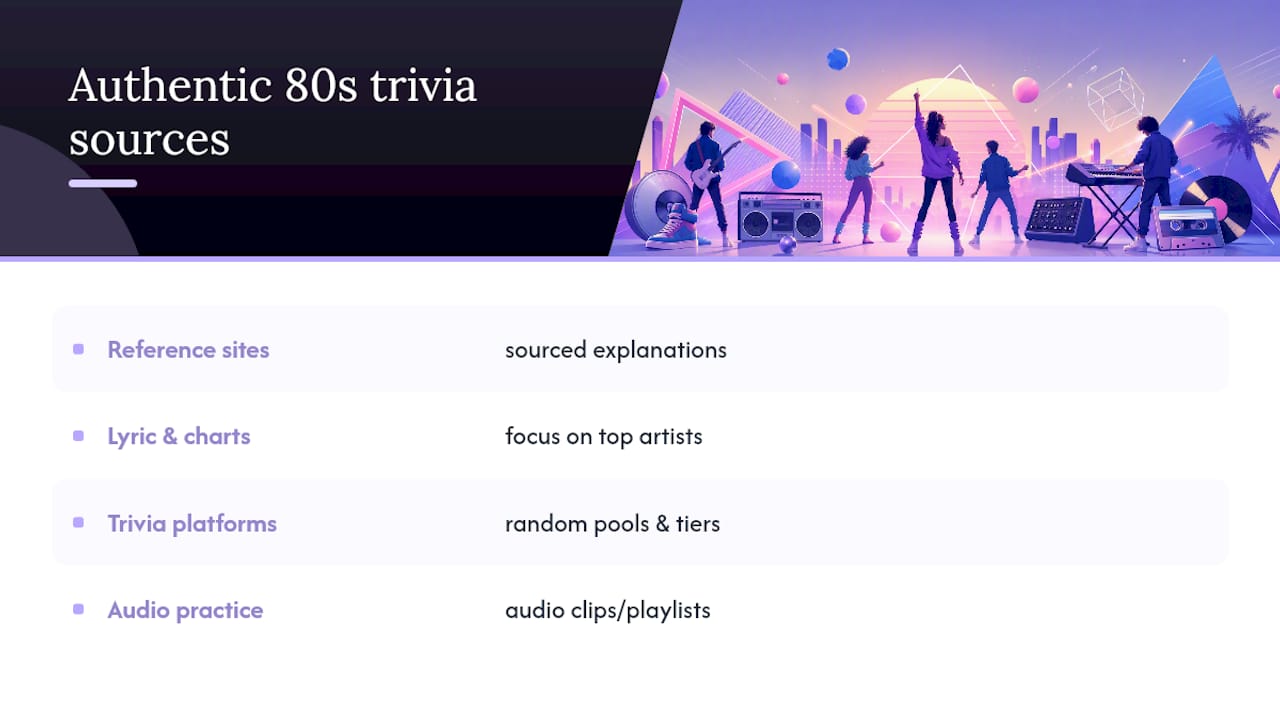
Not every trivia question online is accurate, so sourcing matters if you're building a serious question bank. Reference sites built specifically for factual accuracy, like Britannica's 80s music quiz, model something worth copying: short, sourced explanations after each answer instead of a bare correct/incorrect response.
For lyric-based and chart-history content, Mental Floss leans heavily on the decade's biggest names, noting that Michael Jackson, Madonna, and Whitney Houston dominate most top-of-decade lists because their chart runs were simply longer and bigger than nearly anyone else's.
Dedicated trivia platforms like 80s Music Chart Challenge and Quizzy offer randomized question pools and difficulty tiers, which is useful if you want a fresh round every time instead of memorizing the same 20 questions. ButtonBass takes a similar approach with adjustable difficulty and round length, no account needed.
For song-based practice rather than static trivia, playing actual audio clips beats reading a question cold. That's the gap most trivia sites don't fill, since they're text-first. Pairing a text-based question bank with an audio-driven playlist run gives you both the factual recall and the ear training that expert-level quizzes eventually demand.
What Most Quiz Guides Get Wrong
Most 80s trivia content treats the format as a one-shot: a daily question, a static list, done. That misses what actually makes trivia stick. A single question in isolation teaches you nothing except whether you got lucky. A full run, ten or fifteen songs with a score at the end, teaches you where your knowledge actually breaks down: is it the deep cuts, the production trivia, or just recognizing intros fast enough?
The other overlooked piece is clue economy. Conventional trivia treats hints as a binary, you either know it or you don't. But the better model, where fewer clues used means more points earned, forces real decision-making on every question. That mirrors how actual music fans build expertise: by testing themselves without a safety net first, then checking answers second.
If you're serious about improving rather than just killing time, prioritize playlist-based practice over static question lists. Reading a chart fact once doesn't train your ear. Hearing forty tracks across a few sessions does. The question bank on this page is useful for hosting and quick study, but the real skill building happens when you're guessing songs cold, under a clock, with your points on the line.
— Giacomo
Turn What You've Learned Into a Real Playlist Run
Songle is built for exactly the practice loop described above: short previews, optional clue reveals, and a score that rewards knowing your stuff without extra help. You can play curated 80s playlists free, with no account needed, and get a full scoring summary at the end of the run instead of just a single pass/fail result.
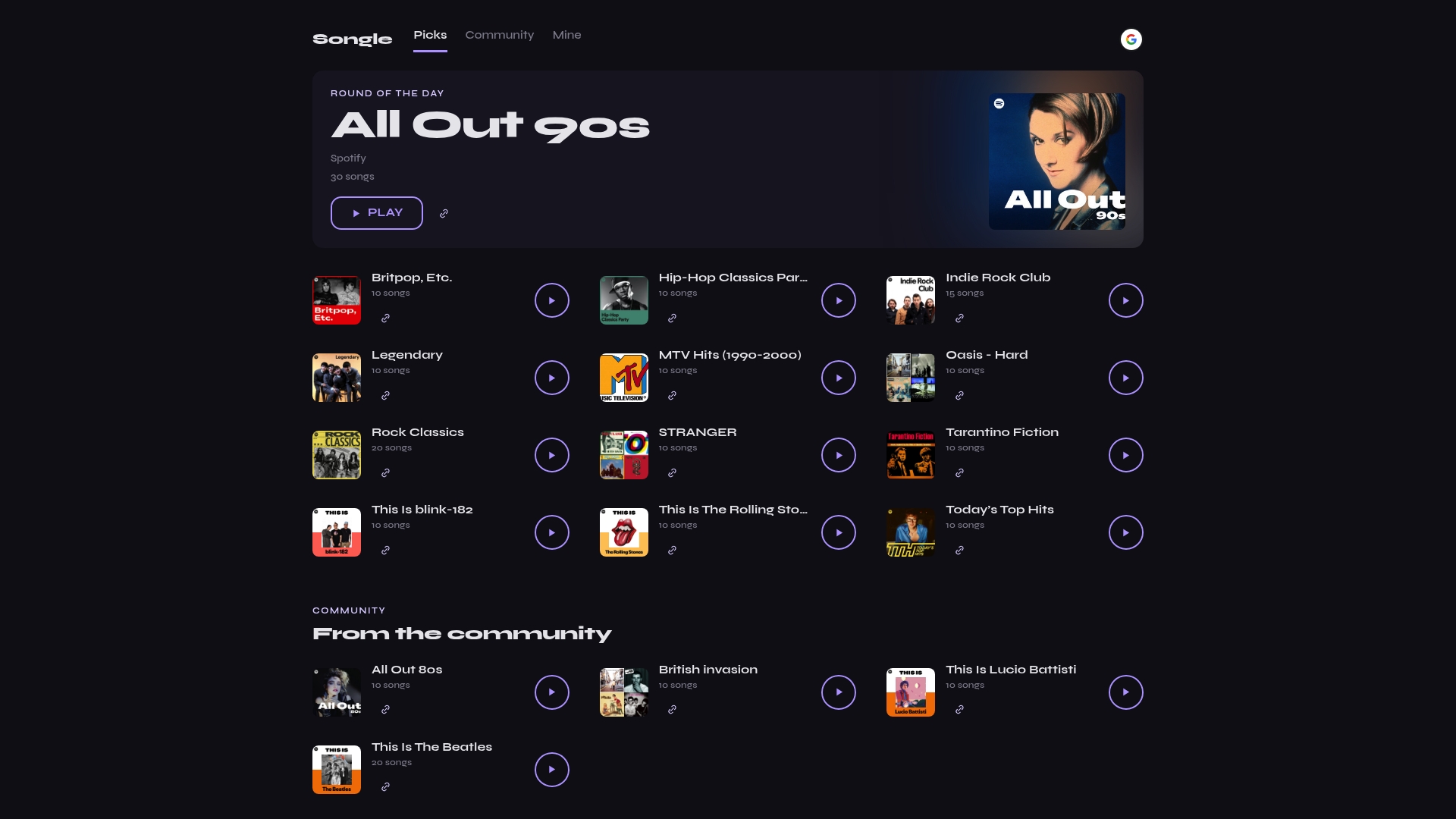
If you want to go further, signing in lets you build a custom quiz from any Spotify playlist and share it with friends through a link, whether that's a deep-cut 80s rock playlist or a lyric-heavy synthpop mix. That part carries a small cost per playlist, but it means the quiz is exactly the songs you picked, not a generic pool.
Head to Songle to start a free curated round right now, or check the FAQ for details on building and sharing your own custom Spotify quiz.